The conversation about AI in finance is changing quickly. Not long ago, the central question was whether artificial intelligence could be trusted to support meaningful finance work at all. Today, the technology is increasingly capable of doing much more than analyzing information or generating recommendations. AI agents can gather evidence, interpret context, route work, communicate with employees and vendors, and, under the right conditions, take action without waiting for a person to approve every step.
For finance leaders, that creates a more consequential question: where should AI be allowed to act first?
The answer matters because finance cannot approach autonomy the way other functions might. A poorly targeted marketing recommendation can be corrected. A financial action can move money, affect an employee or vendor, create an audit issue, or weaken a control. The standard for deciding where AI should act therefore has to be higher than technical capability alone.
This question is becoming more important as finance organizations solve another longstanding problem: visibility. With Oversight, organizations can continuously monitor 100% of spend, rather than relying on approaches that may review only a portion of financial activity. As more risk becomes visible, the operational constraint moves downstream. Finance teams need a better way to determine what requires investigation, what action should follow, and how much of that work can safely be handled by AI.
That is why the first place finance lets AI act should not be determined by what makes the most impressive demonstration. It should be determined by where the organization can establish trust. And trust starts where the rules are already clear.
Autonomy in finance should be earned, not assumed
One of the challenges with the current conversation around agentic AI is that autonomy is often treated as a destination. The assumption is that organizations will begin with AI assistance and steadily remove people from the process until the technology can operate independently.
That may be the direction for some workflows, but it is the wrong objective for finance.
The objective should be to give AI the appropriate amount of authority for the decision being made. Sometimes that means allowing AI to execute an action autonomously. Sometimes it means asking AI to investigate the issue and recommend what should happen next while keeping a person responsible for the final decision. And for some decisions, the appropriate role for AI may remain supportive because the consequences of getting the decision wrong are simply too significant.
This is where finance leaders need to resist the temptation to equate more autonomy with more sophistication. A highly autonomous system is not inherently more valuable than one designed to stop and ask for approval at exactly the right moment. In a high-control environment, knowing when not to act can be as important as knowing what action to take.
The question, then, is not how quickly finance can move toward autonomy. It is how finance determines where autonomy is justified.
Oversight’s approach starts with three considerations: confidence, financial impact, and reversibility. Together, they create a practical way to think about how much authority AI should have in a given workflow.
Start where the policy is already clear
Some finance work is much easier to govern than others. Consider the routine activity that follows a risky transaction. An employee may need to provide a missing receipt. A reviewer may need a summary of the transaction and its history. A finding may need to be routed to a specific person based on risk type or policy. A standard communication may need to be sent. An approved low-risk issue may need to move through a predefined resolution process.
Today, people spend significant time performing these tasks, but many of the decisions behind them are already governed by established rules. Finance knows what information is required, what threshold applies, who owns the next step, and when something needs to be escalated.
Those are strong candidates for the first AI actions because the organization is not asking AI to invent the process. It is asking AI to operate within one that finance has already defined.
Reversibility also matters. If an action can easily be reviewed or corrected before meaningful harm occurs, finance can test AI execution with less exposure. As the financial impact or difficulty of reversing a decision increases, so should the level of human involvement. That is why confidence cannot be the only measure. An AI system may have very high confidence in its recommendation, but confidence does not change the consequence of being wrong. A high-confidence recommendation involving a material payment or a judgment-intensive investigation still deserves a different level of scrutiny than a high-confidence recommendation to request missing documentation.
The appropriate level of autonomy comes from the combination of how certain the system is, what is at stake, and how easily the organization can recover if the decision is wrong.
The first AI actions are likely hiding in work finance already does every day.
High-volume, repeatable activities with established policies and contained consequences can move furthest toward AI execution. Routine follow-up, risk-based routing, case summarization, evidence gathering, and resolution of approved low-risk findings are examples of work where AI can remove manual effort without requiring finance to surrender control over high-consequence decisions. More material or judgment-intensive situations belong somewhere in the middle. AI can still do significant work. It can assemble evidence, identify related activity, summarize what happened, recommend the next step, and prepare the action for a reviewer. The difference is that a person remains responsible for deciding whether that action should proceed.
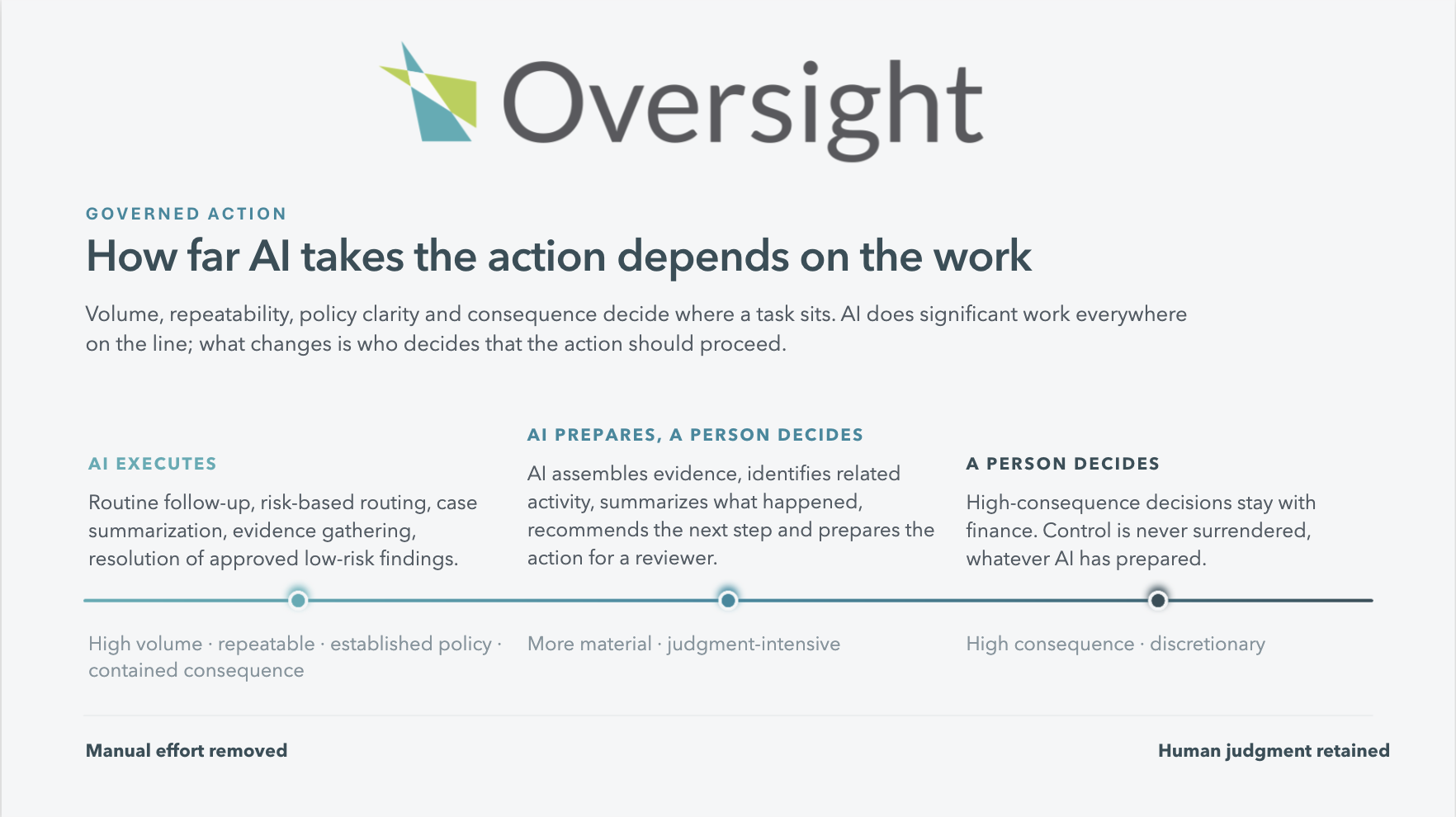
At the other end are decisions where the financial, regulatory, or organizational consequence is significant and difficult to reverse. Here, AI can improve the quality and speed of human decision-making without becoming the final decision-maker. This progression is important because it avoids a false choice between manual work and full autonomy. There is a large amount of finance work where AI can create value before an organization is ready to allow autonomous execution of higher-risk decisions.
Oversight Actions is designed around that reality. As part of the Action Layer within Oversight’s AI-powered Finance Risk Intelligence platform, it extends the intelligence already being used to identify and prioritize risk into the work required to resolve it. Actions remain bounded by customer-configured policies, thresholds, exclusions, escalation rules, and controls.
The distinction is important. Oversight Actions is not a general-purpose agent being handed an open-ended finance process. It acts on risk that Oversight has already identified and contextualized, within boundaries finance has established.
The path to greater autonomy starts with proof
Finance leaders do not need to decide the eventual role of AI before they begin. They need to identify a controlled starting point and establish what the technology must prove before its authority expands. That can begin with Assist Mode. Oversight Actions can summarize risk context, surface relevant history, recommend next steps, prepare communications, and route work while the user retains responsibility for reviewing and approving the action. This gives teams the opportunity to evaluate agents against real transactions, policies, and decisions without immediately changing accountability.
From there, finance can compare outcomes. Did the agent reach the same conclusion as experienced reviewers? How often did people change its recommendation? Did it follow the appropriate policy and escalation path? Can the organization reconstruct why a recommendation was made? And, importantly, did the new process save enough time to make the change worthwhile?
Early Oversight alpha results indicate that Oversight Actions can save roughly 15 minutes per risky transaction reviewed. The significance of that result is not the number alone. It is what the number represents: a measurable way to determine whether AI is removing meaningful work while the organization evaluates the quality and consistency of its decisions.
That is the kind of evidence that can justify the next step.
Once a repeatable workflow demonstrates that it can operate reliably within the organization's controls, finance can expand the boundary into governed execution. The mandate grows because the workflow has earned it, not because the technology is capable of doing more.
Governance has to travel with the action
As agents move from recommending an action to taking one, governance becomes more important, not less.
Finance should be able to reconstruct what happened after every agent-enabled action. What information did the system consider? What policy applied? Why was the action permitted? Did it fall within the appropriate threshold? Was human approval required? If something needs to be challenged later, is there a clear record of the decision?
These are familiar expectations in finance because they are the same expectations organizations already apply to consequential financial processes. Agentic AI does not eliminate them. It makes them more important.
Oversight Actions approaches execution with this principle built into the design. The capability operates within configured policies, thresholds, exclusions, escalation rules, and audit controls, with human involvement where judgment is required.
Every action needs a reason, a boundary, and a record.
That is also what separates governed agentic execution from more generic approaches to automation. A general-purpose agent may be technically capable of communicating with an employee, changing a workflow status, or initiating another step. But technical permission is not the same as financial authority. The surrounding intelligence and governance determine whether the action should happen at all.
This is where Finance Risk Intelligence becomes particularly important. The Action Layer does not operate in isolation. It builds on the Processing Layer that connects financial activity and the Intelligence Layer that evaluates transactions against policy, behavior, peers, related activity, and finance-specific risk models. The action comes after the context and the decision, not before them.
That connected model is what allows organizations to think about agentic AI as part of a controlled finance operating model rather than as another automation tool.
The next yes should depend on what the first one proves
There will not be a single moment when a CFO declares the organization ready for autonomous AI. Different finance decisions will always warrant different levels of authority. A better model is to expand autonomy workflow by workflow.
If AI-supported decisions consistently align with established outcomes, actions remain traceable, reversal rates stay low, and the organization sees meaningful efficiency gains, the case for greater autonomy becomes stronger. If confidence deteriorates, new patterns emerge, or a control weakness becomes visible, finance should be able to narrow the boundary again.
That ability to adjust matters. Governance is not a one-time approval that happens before deployment. It is an operating discipline that determines how AI authority changes as the organization learns. For CFOs, that makes the starting point much less mysterious. Do not begin with the workflow where AI can do the most. Begin where finance already understands the decision well enough to govern it.
Start where the policy is clear, the financial consequence is contained, the action is reversible, and the work happens often enough to prove meaningful value. Then let the results determine what AI gets to do next.
That is how finance moves from experimenting with AI to trusting it to act.
Topics Discussed

.png?width=400&height=200&name=image%20(4).png)