For years, receipt automation was largely a data-entry problem. Finance teams had paper receipts, emailed receipts, PDFs and images, and they needed a faster way to capture basic information such as the merchant, date, line items and total. OCR helped solve that problem by turning information on a document into structured data that other systems could process.
But the risk environment has changed. Finance teams are dealing with growing transaction volumes, fragmented systems and increasingly sophisticated forms of fraud, including documents that can be created or manipulated using AI. In that environment, simply reading what is printed on a receipt is no longer enough.
The harder question is whether the receipt, and the transaction behind it, can actually be trusted.
That distinction matters because a receipt can look completely legitimate to an OCR system while still representing a risky transaction. Modern finance teams need technology that can move beyond extraction to understand context, recognize patterns and help determine what deserves attention. That is the shift from document processing to Finance Risk Intelligence.
A readable receipt can still be a risky receipt
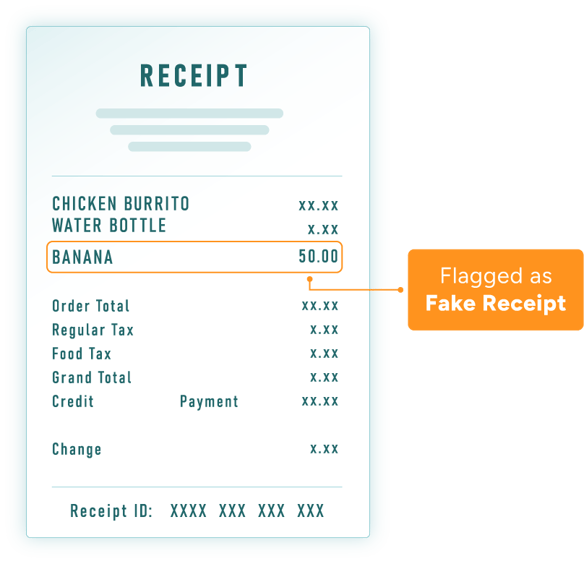
Generative AI has made it easier to create receipts that look remarkably convincing. A fabricated receipt can include realistic formatting, believable line items, an actual merchant and an amount that looks perfectly ordinary. To OCR, there may be nothing unusual about it. The technology is doing exactly what it was designed to do: reading the information on the page.
The problem is that accurately extracting fabricated information does not make that information trustworthy.
The scale of the issue is becoming clearer. In a 2026 survey conducted by Atomik Research for Emburse, 34% of finance and business professionals surveyed said they had used AI to create a fake receipt. That finding points to a larger challenge for finance teams. As creating convincing documentation becomes easier, controls that depend primarily on whether a document looks complete and readable become less effective.
The risk can also be difficult to spot because suspicious activity does not always involve an obviously large or unusual purchase. It may appear as smaller transactions repeated over time, transactions kept below approval thresholds or receipts that have been slightly altered and resubmitted. Looking at each document in isolation can make those patterns difficult to recognize.
Finance teams therefore need to understand more than what a receipt says. They need to understand the context surrounding it.
Reading a receipt is not the same as understanding it
Traditional receipt analysis can create another problem: noise.
Consider an expense policy that restricts alcohol purchases. A keyword-based system may search receipts for terms such as “gin,” “bourbon” or “vodka.” That sounds reasonable until legitimate transactions start getting flagged because an employee ate at a restaurant with “Gin” in its name, ordered a root beer, purchased bourbon-glazed salmon or had pasta alla vodka.
The system technically found the keyword it was looking for, but it did not understand what the keyword meant in context.
When that happens repeatedly across a large volume of transactions, finance teams can spend valuable time reviewing activity that poses little or no meaningful risk. Meanwhile, truly risky transactions can become harder to find among all that noise.
This is the difference between visibility and intelligence. Visibility tells you what is there. Intelligence helps you determine what matters.
That distinction is central to Finance Risk Intelligence. The goal is not to flag as much activity as possible. It is to bring together the signals surrounding a transaction, evaluate them in context and help finance teams focus their attention where it can have the greatest impact.
What does it mean to actually understand a receipt?
True receipt intelligence requires more than better character recognition. It requires multiple forms of analysis working together to build a more complete picture of the transaction.
That includes the ability to:
- Understand line items in context. A word should not automatically trigger a risk identified simply because it appears on a receipt. The system needs to consider the merchant, item description, transaction context and applicable company policy before determining whether the purchase warrants review.
- Evaluate document authenticity. Modern analysis should look beyond the text itself and examine signals that could indicate a receipt has been generated, manipulated or otherwise altered.
- Recognize relationships across transactions. Two receipts may not be exact copies but could still represent the same underlying purchase. Changes to cropping, formatting or other document characteristics should not prevent technology from identifying potentially related activity.
- Work across languages and formats. Global organizations encounter receipts from different countries, merchants, languages and document types. Effective analysis needs to account for that variation without forcing finance teams to manually interpret every unfamiliar document.
Individually, each capability provides another signal. Together, they help finance teams develop a much stronger understanding of whether a transaction represents meaningful risk.
Processing is only the first layer
This is why Oversight approaches receipt analysis as part of a broader Finance Risk Intelligence platform rather than as a standalone document-processing problem.
Processing still matters. Finance teams need accurate, reliable data before they can make good decisions. But processing is the foundation, not the destination.
Oversight brings together three layers of intelligence to help finance teams move from fragmented transaction data to informed action.
The Processing Layer connects the activity. It brings together records from across finance systems and reconciles them into trusted business context. For receipt analysis, that means the document does not have to be evaluated as an isolated image. It can be understood alongside the transaction and other relevant information.
The Intelligence Layer decides what matters. Oversight evaluates transaction context using policy, behavioral patterns, related activity, document analysis, merchant intelligence and other risk signals. Instead of relying on a single keyword or rule, multiple signals can corroborate or challenge one another to provide a more complete view of risk.
The Action Layer helps teams act and learn. Once meaningful risk is identified, Oversight helps prioritize the activity that deserves attention and provides the context needed to investigate it. The outcome of that review then becomes part of the intelligence that can inform future decisions.
Together, these layers create a continuous loop: connect the activity, understand the risk, take the appropriate action and learn from the outcome.
That is fundamentally different from simply extracting text from a receipt.
Less noise. More meaningful risk.
Receipt Analytics from Oversight applies this Finance Risk Intelligence approach to one of the most familiar pieces of evidence in expense review: the receipt.
Instead of asking only whether certain words or values appear on the document, Receipt Analytics helps evaluate what those details mean within the broader context of the transaction. That allows finance teams to distinguish between activity that merely looks unusual and activity that represents meaningful risk.
For finance teams, the benefit is not simply finding more things to review. It is improving the quality of what gets surfaced in the first place. Better context can reduce unnecessary investigations while helping teams recognize suspicious patterns and risky transactions that simpler approaches may overlook.
Because seeing everything is not the goal. Understanding what matters is.
Finance risk requires intelligence, not just extraction
OCR solved an important problem for finance. It helped turn documents into data and made expense processes faster and more scalable.
But today’s finance teams face a different challenge. AI-generated documentation, increasingly sophisticated fraud, fragmented systems and growing transaction volumes are changing what effective risk management requires. Extracting information from a receipt is only one step. Finance teams also need to understand whether the transaction makes sense, whether the evidence can be trusted, how it relates to other activity and whether someone needs to act.
That requires technology designed not simply to process financial activity, but to understand it.
That is Finance Risk Intelligence.
See what Receipt Analytics can uncover in your own spend. Request an Oversight demo.






.png?width=400&height=200&name=image%20(4).png)