At the end of every month, finance teams process thousands of expense reports, including airfare receipts, client dinners, conference travel, office purchases.
Most look perfectly normal.
Hidden among them, however, may be something entirely synthetic: a receipt that never existed, generated by AI in seconds and designed to look indistinguishable from a real transaction.
This is the new frontier of expense fraud.
Generative AI can now produce highly realistic financial documents at scale. These receipts replicate vendor logos, formatting patterns, pricing structures, and timestamps with alarming accuracy. What once required skill and time can now be created instantly with a simple prompt.
Modern generative models are trained on vast datasets of documents, invoices, and transactional artifacts. When prompted, they do not simply “draw” a receipt; they synthesize statistically consistent financial artifacts, replicating layout structures, vendor naming conventions, tax formatting, currency patterns, and itemization styles.
In other words, these receipts are not crude forgeries. They are synthetic financial documents built from learned patterns of legitimate transactions.
The result is a fundamental shift in financial risk. Fraud is no longer limited by human effort; it is now algorithmically scalable.
The Rise of AI Receipts
Just a few years ago, fraudulent receipts were relatively easy to spot for companies with proper controls in place. A blurry font or a suspicious vendor name was a minor imperfection that indicated potential fraud. More importantly, fraud was constrained by human effort. It took time and skill to fabricate realistic documents, making most small-scale receipts not worth the effort. AI has removed those limits.
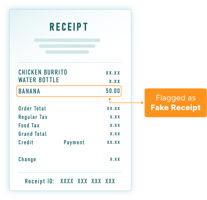
Today, financial documents that mirror real vendors can be produced in seconds and multiplied across thousands of submissions. To generate a fraudulent receipt, all someone needs to do is prompt an AI engine with a request such as: “Generate a realistic receipt from Restaurant X in Atlanta, dated February 24, for a total of $522.” The model will then analyze thousands of real receipts from the requested restaurant and generate a single receipt that matches the prompt's specifications exactly.
Some large language models, including ChatGPT, incorporate safeguards designed to prevent the generation of fraudulent receipts, such as refusal policies that block such requests. Additional barriers exist beyond the model itself: AI cannot generate valid transaction IDs or reproduce the embedded metadata present in authentic receipts. However, these protections are not absolute and can be easily missed during manual review.
The Emergence of Synthetic Expense Fraud
Security researchers increasingly refer to this emerging category as synthetic fraud, financial artifacts generated by algorithms rather than manipulated by humans.
In the expense management domain, this means AI-generated receipts, invoices, or travel documents that appear authentic but have no underlying transaction.
Unlike traditional fraud, synthetic fraud is programmable, scalable, and increasingly difficult for human reviewers to detect.
The Faults with Legacy Controls
Finance controls have historically been built around human review and judgment, involving manager approvals, finance team reviews, and periodic audits. These systems rely on human oversight to identify and flag anything out of the ordinary.
Traditional expense controls were designed for a different era, an era when fraud required effort, time, and human skill. Manager approvals, random sampling audits, and manual receipt reviews were effective when fraudulent documents were rare and often poorly fabricated.
Traditional manual audits review only a small, random subset of receipts and usually occur after reimbursements have already been issued. When auditing, human reviewers focus on obvious red flags, such as unusually high spend, duplicate submissions, or suspicious timestamps.
But these controls were never designed to defend against machine-generated fraud operating at scale.
That is no longer today’s environment.
AI-driven fraud now stays within normal ranges, quietly bypassing legacy checkpoints. Without the ability to analyze patterns across thousands of submissions or access embedded metadata, manual oversight is increasingly ineffective.
In an AI-driven fraud environment, manual review becomes mathematically insufficient. When fraud can scale across thousands of transactions, even a small percentage of undetected activity can translate into significant financial losses.
Impact on the Bottom Line
While one or two fake receipts may seem insignificant, AI enables this type of fraud at a scale never before possible, making larger organizations particularly vulnerable. Consider a finance team that processes 5,000 expense reports per month with an average reimbursement of $200. That represents $1 million in monthly expense volume.
If just 2% of those expenses are fraudulent and go undetected, the result is $20,000 in losses each month, or $240,000 per year. If the fraud rate rises to 4%, losses climb to $40,000 per month and nearly $500,000 per year.
This simple calculation illustrates how even a small percentage of undetected fraud can translate into substantial financial impact, especially as AI-generated receipts increase in volume and sophistication. Across large enterprises processing tens of thousands of monthly expense transactions, even small fraud rates can quietly compound into millions of dollars in leakage over time.
The consequences extend beyond the immediate financial loss. When fraudulent documents enter financial records, audit costs rise as auditors spend more billable time verifying expenses. Budget accuracy can also suffer, as finance teams make planning decisions based on data that has been quietly distorted by fraud.
Introducing Finance Risk Intelligence (FRI)
To address this new expense management environment, a new operational category has emerged to help enterprises evolve: Finance Risk Intelligence (FRI).
According to the Everest Group, a global research firm, FRI offers a layered, AI-powered approach to risk management. It processes and analyzes thousands of transactions in real time, integrating seamlessly with systems such as ERP, accounts payable, expense management, procurement, and payments.
Everest Group’s research shows that while finance operations have modernized rapidly, risk management has struggled to keep pace. FRI helps close that gap by enabling organizations to move beyond traditional, retrospective controls.
Rather than relying on periodic audits or manual review, FRI platforms continuously analyze financial activity across enterprise systems, including expense management, procurement, accounts payable, and payments, identifying patterns of risk as they occur.
FRI represents a transition from reactive financial controls to continuous, AI-driven risk intelligence.
For AI-generated documents, FRI systems look beyond surface appearance and analyze deeper signals, such as metadata consistency, formatting structures, submission timing, and relationships between fields. These indicators are often invisible to the human eye, but FRI can analyze thousands simultaneously and compare them against continuously expanding datasets.
Adapting to the New Era of Finance
Generative AI has permanently changed the economics of financial fraud. What was once difficult and rare can now be automated, scaled, and hidden in plain sight.
But the same technologies that enable synthetic fraud also enable its detection.
In the coming years, the most resilient finance organizations will be those that embrace this reality: in an AI-driven world, the only effective defense against AI-powered fraud is AI itself.
.jpg?width=48&height=48&name=Amirtharaj-Karuppaiah%20(1).jpg)




.jpg?width=200&height=200&name=Amirtharaj-Karuppaiah%20(1).jpg)

.png?width=400&height=200&name=image%20(4).png)